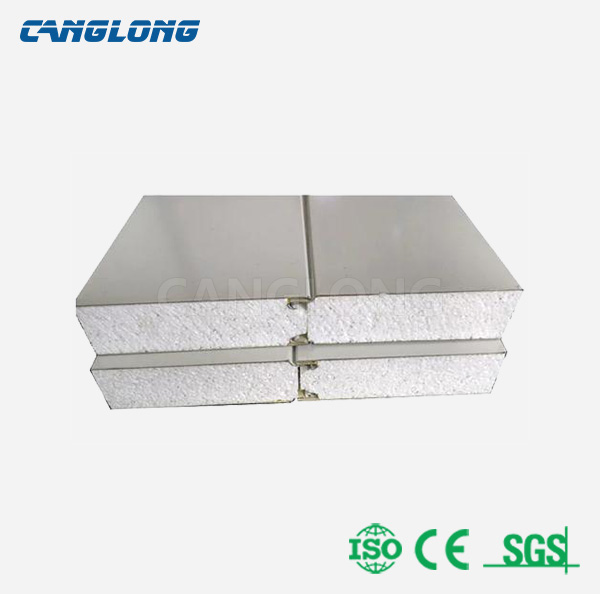
Polystyrene Cladding Panels
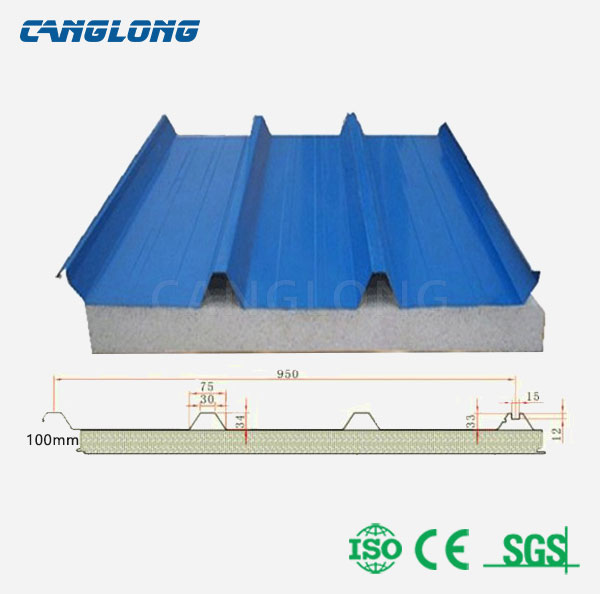
- Effective Width: 950/1150mm
- Metal Sheet Thickness: 0.2mm to 0.8mm
- Coating: PE/HDP/PVDF/SMF
- Plating: Hot-galvanize/Aluminium/Stainless
- Color of Steel Plate: White/Offwhite/Blue or Customized
- Core Material: Polystyrene (EPS)
- Core Thickness: 50/75/100/150/200mm
- Delivery Time: 7-15 days
- Shipping Port: Qingdao Port
- Payment: T/T, L/C, PayPal
- Service Life: ≥15 years
- Product Origin: Henan, China
Product Details
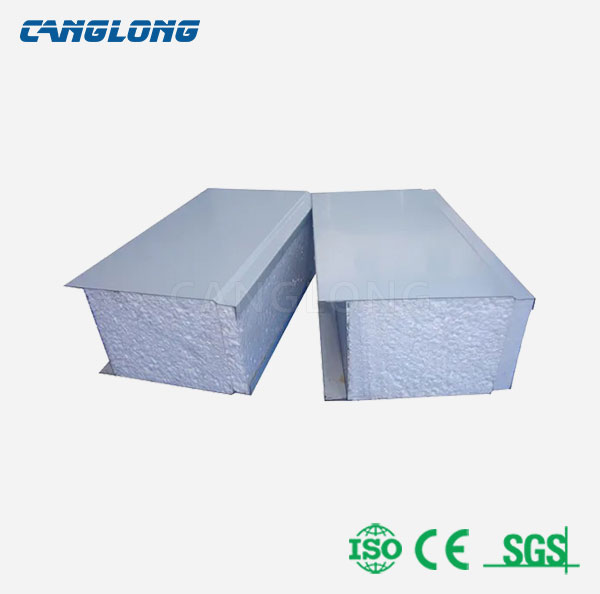
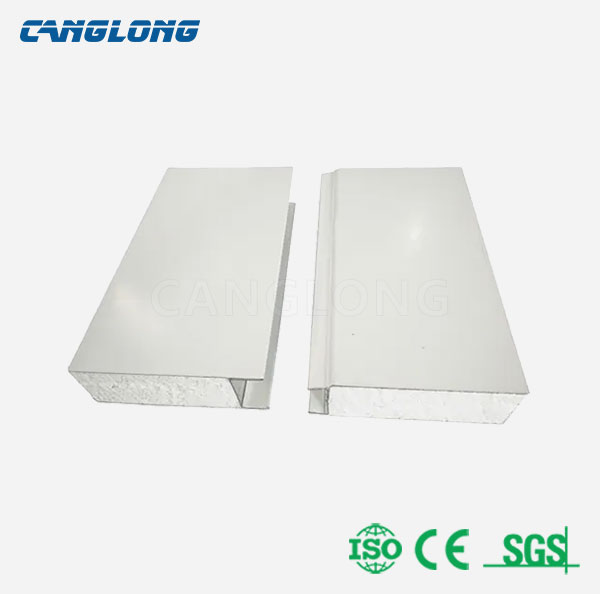
Polystyrene cladding panels are prefabricated building cladding panels made with expanded polystyrene (EPS) or extruded polystyrene (XPS) as the core material and a composite decorative and protective layer on the surface. They are also known as polystyrene sandwich cladding panels, EPS/XPS integrated insulation and decoration panels, or polystyrene insulation clad panels.
Polystyrene cladding panels combine thermal insulation, waterproofing, moisture resistance, aesthetic appeal, and enclosure functions. They are lightweight, economical, and easy to install, and are widely used globally in building exteriors, roofs, cold storage facilities, clean rooms, modular buildings, and temporary structures. The surface material, core material type, thickness, color, texture, and edge structure can be customized according to different national and regional building codes, climate conditions, and project requirements.
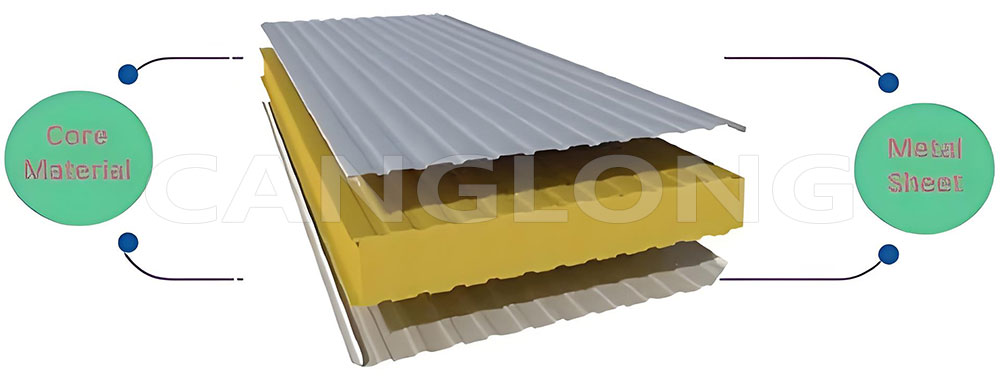
Product Structure
| Component | Optional Material | Common Specifications |
|---|---|---|
| Surface layer | Color-coated steel sheet, aluminum sheet, stainless steel sheet, fiber cement board, calcium silicate board, PVC film, etc. | Steel sheet 0.3–0.8 mm; aluminum sheet 0.5–1.2 mm; cement board 6–12 mm |
| Core | Expanded polystyrene (EPS), extruded polystyrene (XPS) | EPS density 12–25 kg/m³; XPS density 25–45 kg/m³ |
| Back layer | Aluminum foil, color-coated steel sheet, non-woven fabric, cement board, etc. | Customized according to project |
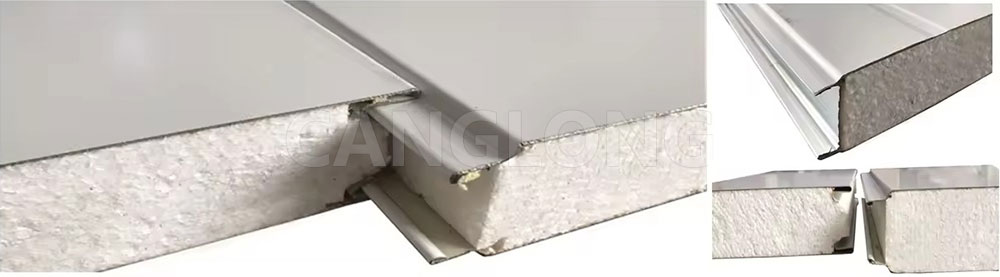
| Edge | Square edge, tongue-and-groove, grooved, interlocking; optional polyurethane edge sealing | Customized according to system |
| Surface coating | PE, PVDF, polyester, fluorocarbon, etc. | Selected according to weather resistance requirements |
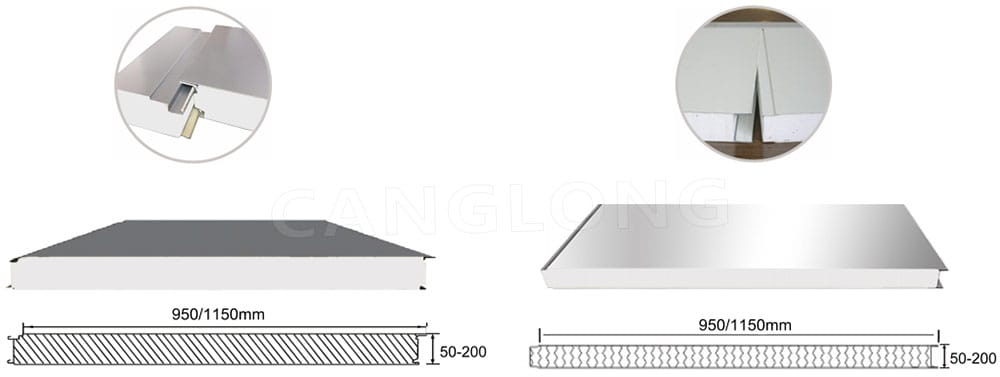
Product Specifications
| Parameter | Range |
|---|---|
| Total thickness | 50–200 mm |
| Effective width | 950–1150 mm |
| Panel length | Up to 12,000 mm, customizable |
| Core type | EPS / XPS |
| Surface texture | Flat, embossed, wood grain, stone grain, brick grain, brushed metal, etc. |
| Color | RAL color chart or customer specified |
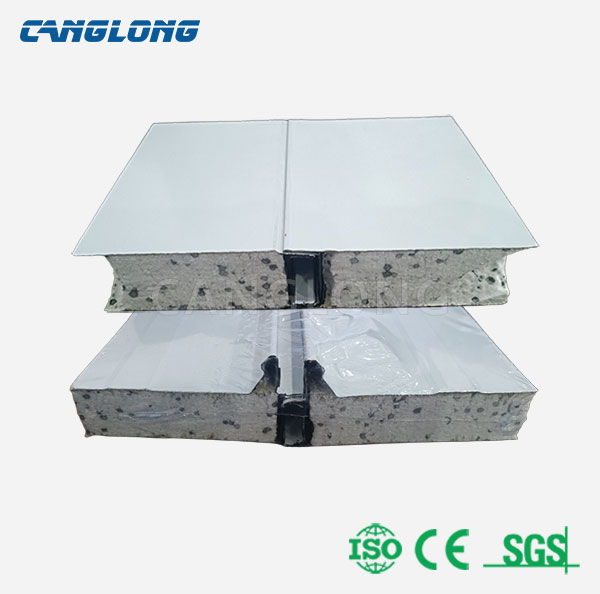
| Connection method | Tongue-and-groove interlocking, concealed fixing, exposed screw fixing, adhesive-anchor combined fixing |
Polystyrene Cladding Wall Panel – Span Table
| Non-Cyclonic Reqion A&B | Cyclonic Reqion A&B | ||
| Wind Speed (km/h) | Span (mm) | Wind Spend (km/h) | Span (mm) |
| 118.8 | 5400 | 147.6 | 3600 |
| 147.6 | 4200 | 180 | 3000 |
| 180 | 3600 | ||
Performance Advantages
Lightweight and High-Strength
Polystyrene cladding panels typically weigh 10–30 kg/m², significantly reducing the structural load on buildings and facilitating transportation and installation. The composite surface and core material provides excellent bending and impact resistance, making them suitable for various enclosure systems. Thermal Insulation
EPS typically has a thermal conductivity of 0.032–0.038 W/(m·K), while XPS typically has 0.028–0.034 W/(m·K). The closed-cell structure effectively reduces heat conduction, lowering building heating and cooling energy consumption. Specific thermal performance depends on the board thickness, core material density, and system construction.
Waterproofing and Moisture Resistance
XPS has extremely low water absorption and a good closed-cell structure, making it suitable for humid environments. EPS requires a complete waterproofing system through surface layers, sealants, and edge treatments. The board surface is smooth, preventing water accumulation, and can be used with flashing and sealing strips.
Aesthetically Pleasing and Decorative
Surface layers are available in a variety of colors, textures, and surface effects, such as stone, wood, brick, and metallic finishes, to meet the needs of different architectural styles in commercial buildings, residences, and public facilities.
Sound Insulation and Noise Reduction
Depending on the system structure and panel thickness, airborne sound insulation (Rw) typically reaches 20–30 dB, suitable for factories, machine rooms, and commercial spaces with specific noise control requirements.
Easy Construction
Factory prefabrication and on-site dry installation are possible using keel fixing, adhesive anchoring, or tongue-and-groove joints. Construction cycle is short, less affected by weather, and facilitates rapid construction of old buildings and modular buildings.
Economy and Environmental Protection
Polystyrene materials are relatively inexpensive, easy to maintain, and recyclable. Modern foaming processes can use environmentally friendly foaming agents that are free of CFCs and HCFCs; specific requirements are subject to product testing reports and local environmental regulations.
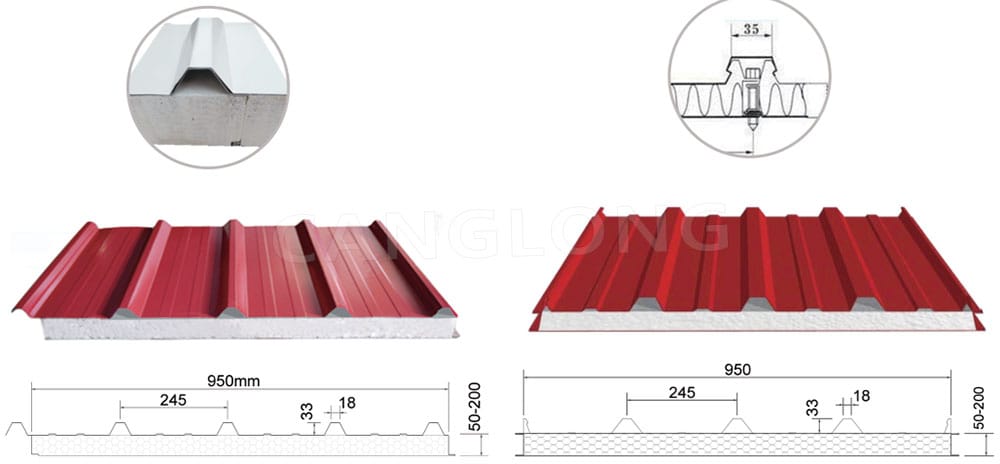
Polystyrene Cladding Roof Panel – Span Table
| Thickness (mm) | Single span(mm) | Multi-span(mm) | ||||||||||||
| 1500 | 2700 | 3900 | 5100 | 6300 | 7500 | 8700 | 1500 | 2700 | 3900 | 5100 | 6300 | 7500 | 8700 | |
| 50 | 5.16 | 2.35 | 1.28 | – | – | – | – | 4.15 | 2.07 | 1.17 | – | – | – | – |
| 75 | 7.70 | 3.74 | 2.00 | 1.21 | – | – | – | 5.9 | 2.91 | 1.72 | 1.11 | – | – | – |
| 100 | 9.41 | 4.63 | 2.55 | 1.53 | 1.04 | 0.76 | – | 7.61 | 4 | 2.41 | 1.58 | 1.1 | – | – |
| 125 | 10.98 | 5.55 | 3.11 | 1.86 | 1.25 | 0.92 | – | 7.74 | 4.25 | 2.95 | 1.98 | 1.4 | 1.03 | – |
| 150 | 13.26 | 6.78 | 3.67 | 2.19 | 1.47 | 1.07 | 0.82 | 7.74 | 4.35 | 3.04 | 2.35 | 1.77 | 1.31 | – |
Fire Protection and Compliance
Polystyrene is an organic thermal insulation material. Ordinary polystyrene is combustible, while flame-retardant polystyrene can reach B1 or B2 ratings (specific requirements are subject to testing reports). Unlike Class A non-combustible materials such as rock wool, polystyrene cladding panels used for building exterior walls, roofs, or high-rise buildings must comply with the fire safety regulations of the project location.
For areas with high fire safety requirements, the following measures are recommended:
- Establish fire-resistant barriers;
- Use non-combustible surface layers or fire-resistant construction;
- Avoid direct contact between electrical wiring and high-temperature equipment and the core material;
- Conduct system fire resistance testing and certification according to local regulations.
Fire resistance and performance testing available for polystyrene clad panels includes EN 13501-1, ASTM E84, GB 8624, etc. Specific ratings are subject to the actual product and system test reports.
Technical Parameter Reference
| Item | EPS Core | XPS Core |
|---|---|---|
| Density | 12–25 kg/m³ | 25–45 kg/m³ |
| Thermal conductivity | 0.032–0.038 W/(m·K) | 0.028–0.034 W/(m·K) |
| Water absorption | ≤4% | ≤1% |
| Compressive strength | 100–250 kPa | 150–500 kPa |
| Fire rating | B1/B2 (flame-retardant type) | B1/B2 (flame-retardant type) |
| Service temperature | -40°C to +70°C | -50°C to +75°C |
| Dimensional stability | ≤1.5% | ≤1.0% |
The above are typical reference values; actual performance is subject to product test reports and project system specifications.
Application Scenarios
Exterior Wall Insulation and Decoration
Polystyrene cladding panels are suitable for exterior wall insulation and decoration in residential buildings, office buildings, commercial complexes, hotels, schools, hospitals, etc., and can imitate stone, wood, and brick, enhancing the building’s appearance.
Roof Insulation Cladding
Polystyrene clad panels are used in industrial plants, logistics warehouses, and commercial building roofs, combining insulation, waterproofing, and decorative functions.
Cold Storage & Cold Chain
XPS core material has low water absorption and good insulation performance, suitable for low-temperature environments such as cold storage, cold storage rooms, and food processing workshops.
Cleanrooms & Industrial Plants
Polystyrene cladding panels are used for partitions and ceilings in cleanrooms in electronics, pharmaceuticals, food, and cosmetics industries. The surface is smooth and easy to clean.
Modular Buildings & Temporary Construction
Container houses, guard booths, mobile homes, campsites, etc., are quick to install and reusable.
Old Building Renovation & Refurbishment
Existing walls can be directly covered, reducing demolition work and improving insulation and appearance.
Standards & Certifications
| Standard | Scope |
|---|---|
| EN 13501-1 | Reaction-to-fire classification of construction products |
| EN 14509 | Self-supporting double-skin metal-faced insulating panels |
| ASTM E84 | Surface burning characteristics of building materials |
| ASTM C518 | Steady-state thermal transmission properties |
| ASTM E90 | Laboratory measurement of airborne sound transmission loss |
| GB 8624 | Classification for burning behavior of building materials and products |
| GB/T 23932 | Metal-faced insulating sandwich panels for buildings |
| ISO 9001 | Quality management system |
| CE certification | Available for European market compliance |
Polystyrene cladding panel can be manufactured according to the ISO 9001 quality management system, and CE, ASTM, EN, or GB test reports are provided depending on the project location. Fire safety regulations vary significantly between countries; it is recommended to confirm local building codes before selection.
Installation Points
Substrate Preparation: The wall surface should be flat, dry, and free of oil stains and loose materials.
Fixing Methods: Fixing can be achieved using a keel system, a combination of adhesive and anchoring, or tongue-and-groove joints. Concealed fixing improves the appearance.
Seam Treatment: Seams should be treated with weather-resistant sealant, sealing strips, or waterproof tape to prevent rainwater penetration.
Fireproofing: Fire barriers should be installed according to local regulations to prevent direct exposure of the core material to fire sources.
Thermal Expansion and Contraction: Polystyrene materials are subject to thermal expansion and contraction; appropriate expansion joints should be provided during installation.
Construction Environment: Avoid installation in rain, snow, or strong winds; keep away from open flames and high temperatures.
Protective Film: Remove the protective film promptly after installation to prevent residue buildup from prolonged exposure to sunlight.
Polystyrene Wall Panel Installation
Polystyrene Roof Panel Installation
Packaging and Delivery
Polystyrene cladding panels are packaged to export standards with a protective film on the surface. Pallets, wooden crates, or custom packaging are available, suitable for sea freight and long-distance transport. The standard delivery time is 15–30 days after order confirmation, depending on order quantity, customization requirements, and shipping arrangements.
Contact & Inquiry
For polystyrene clad panel product samples, technical data, test reports, or project quotations, please contact the Canglong International Sales Team. We offer OEM/ODM services and can customize polystyrene clad panels according to project location, climate conditions, fire resistance rating, wind load, color, and quantity.
When inquiring, we recommend providing the following information:
- Project country/region;
- Application area (exterior walls, roofs, cold storage, clean rooms, etc.);
- Fire resistance requirements;
- Board thickness, width, and length;
- Surface material and color;
- Order quantity and delivery time.
We will provide you with suitable polystyrene cladding panels solutions based on the standards and needs of different global markets.
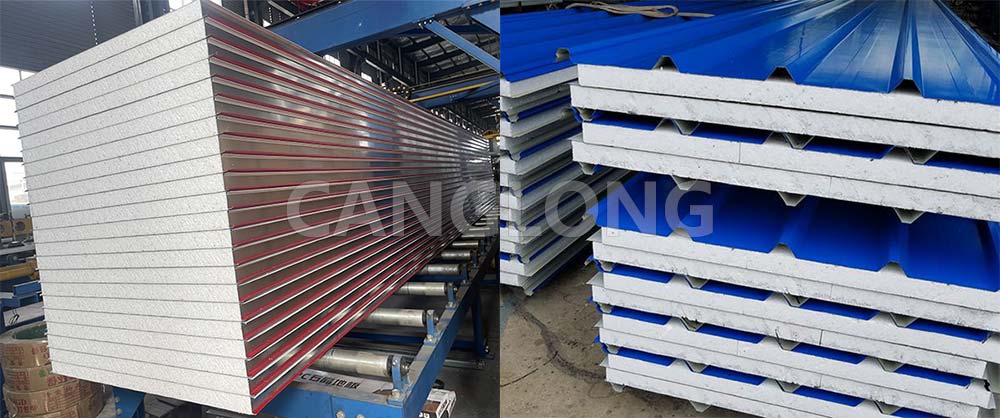
Sandwich Panel Production Workshop

Sandwich Panel Packing & Shipping
All the products are loaded at the loading site of our factory using crane and forklift by our skilled workers, who will prevent the goods to be damaged. And all the structure components, panels, bolts and sorts of accessories will be well packed with standard package and it is suitable for ocean transport.
Inspection: 50% inline inspection and 100% full final inspection, make sure all output w/o any mistake.
Packing: Per customer's requirements or per product sizes, full protection packing.
Shipping: Per customer's requirements or per container sizes.
Unloading: We package it as a whole and can be easily pulled out at once with a forklift, which is very convenient.

Our Certificates
Our sandwich panel certificates include EU CE certification, BPS certification, and ICC certification.

Application of Sandwich Panels
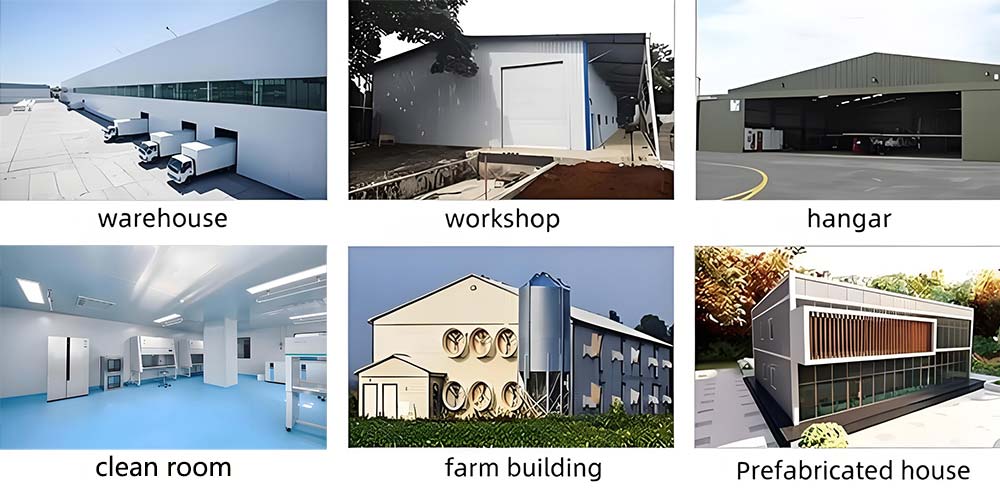
Usage scenario: Insulated sandwich panels are used as exterior walls and interior partitions, installed vertically or horizontally on single span or multi span structures. Such as industrial buildings, steel frame structures, warehouses and logistics centers, commercial buildings and offices, fire-resistant buildings, agricultural and livestock buildings, sports halls, exhibition halls, factories, garages, hangars, barns, prefabricated houses, cold storage, clean room, etc.

We provide the following RAL color card colors for your reference. For other colors, please compare the Raul color card colors.
Note: The above color card has a slight deviation due to printing reasons, please refer to the actual products.


If you purchase metal sandwich panels from Canglong Group, we will also provide some accessory products, including self tapping nails, rivets, waterproof caps, polyurethane glass glue, mouth and corner accessories, outer ridge tiles, waterproof eaves, external and internal corners, eaves edging, plugs, door and window edging, purified aluminum profiles, etc.


High-quality Raw Materials
We strictly select high-quality suppliers. All color steel coils and core materials are from China top 500 companies and have undergone strict quality inspections to ensure the basic quality of the products.
-


Advanced Production Equipment
The factory is equipped with advanced production equipment, including automated production lines, cNc cutting machines and high-precision pressing equipment, to ensure that the production process of each color steel sandwich panel is accurate and stable.
-

Mature Supply Solutions
One-stop supply of all accessories for sandwich panel installation, standardized packaging process, to avoid friction or damage of sandwich panels on the road, easy for customers to unload, saving time and money for customers.
-

Q1: What are the main applications of polyurethane sandwich panels?
A: Polyurethane sandwich panels are commonly used for insulation and construction in various building types, including residential, commercial, industrial, and agricultural structures. They are suitable for walls, roofs, ceilings, and floors.
Q2: What are the advantages of polyurethane sandwich panels?
A: Polyurethane sandwich panels offer excellent thermal insulation properties, lightweight construction, high strength-to-weight ratio, versatility, weather resistance, fire resistance (with appropriate treatments), aesthetic appeal, and cost-effectiveness.
Q3: How do polyurethane sandwich panels contribute to energy efficiency?
A: Polyurethane sandwich panels provide effective thermal insulation, reducing heat transfer through walls and roofs. This helps maintain comfortable indoor temperatures and reduces the energy required for heating and cooling, thus contributing to energy efficiency and lower utility bills.
Q4: Are polyurethane sandwich panels environmentally friendly?
A: Polyurethane sandwich panels can be environmentally friendly when produced using sustainable manufacturing practices and materials. Additionally, their energy-saving properties contribute to overall environmental sustainability by reducing energy consumption and greenhouse gas emissions.
Q5: How durable are polyurethane sandwich panels?
A: Polyurethane sandwich panels are known for their durability and resistance to various environmental factors, including weather, moisture, and corrosion. Proper installation and maintenance can further enhance their longevity.
Q6: Are polyurethane sandwich panels easy to install?
A: Yes, polyurethane sandwich panels are relatively easy to install compared to traditional building materials. Their lightweight nature and standardized dimensions facilitate quick and efficient installation, resulting in reduced construction time and labor costs.
Q7: Can polyurethane sandwich panels be customized?
A: Yes, polyurethane sandwich panels can be customized to meet specific design requirements, including color, finish, thickness, and profile. Customization options allow architects and builders to achieve desired aesthetics and performance characteristics for their projects.
Q8: How do I maintain polyurethane sandwich panels?
A: Maintenance requirements for polyurethane sandwich panels are minimal. Regular cleaning with mild detergent and water, inspection for any damage or deterioration, and prompt repair of any issues are recommended to ensure optimal performance and longevity.
Product Features
The metal sandwich panels produced by Canglong are insulated, fire-resistant, environmentally friendly, earthquake resistant, and durable.