
Color steel sandwich panels are an all-round solution in the construction field
In today’s rapidly developing construction industry, material selection is directly related to project efficiency, cost control and long-term benefits. With its excellent physical properties and flexible application scenarios, color steel sandwich panels have transformed from traditional industrial building materials into preferred products covering many fields. This article will provide an in-depth analysis of the specific applications and core advantages of color steel sandwich panels from a broader perspective, and provide users with practical reference.
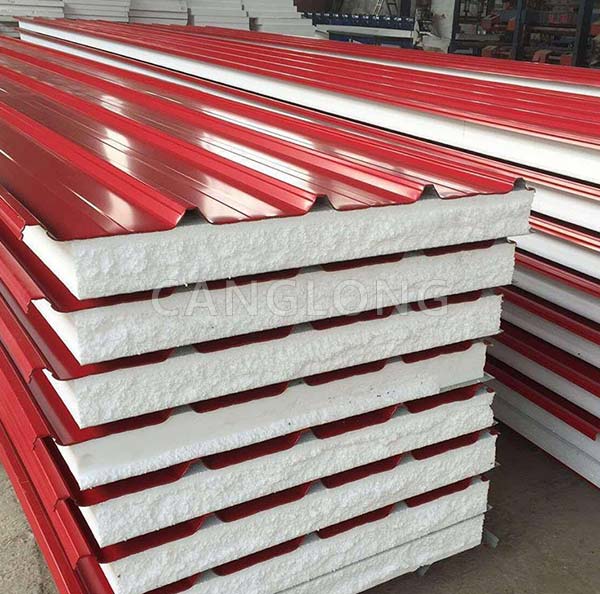
Adaptability across industries and climates
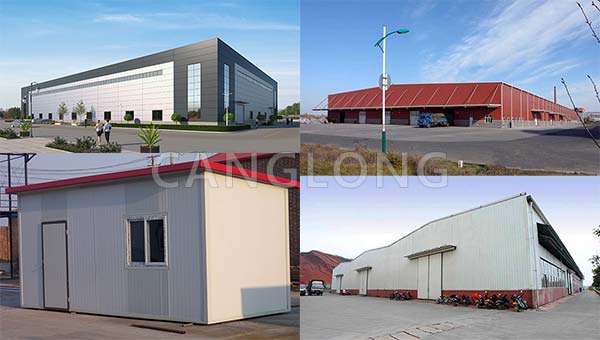
The modular nature of color steel sandwich panels allows them to be easily adapted to different building needs. They can be seen everywhere from polar scientific research stations to tropical logistics centers, from permanent landmarks to temporary rescue facilities.
1.1. Industrial and logistics fields
As the birthplace, the industrial field is still the main battlefield for color steel sandwich panels. Heavy machinery plants, chemical workshops, and large storage centers use it as an enclosure system, not only because the installation speed is more than three times faster than traditional masonry, but also because rock wool core materials can effectively deal with high-temperature equipment and potential fire risks. In the port logistics park, its wind resistance can withstand typhoons and ensure the safety of goods.
1.2. Cold chain and food supply chain
The expansion of fresh food trade has led to a surge in demand for cold chain facilities. The thermal conductivity of polyurethane sandwich panels is as low as 0.018-0.024W/(m·K). Taking a 100mm thick plate as an example, the thermal insulation effect is equivalent to a 1.5-meter-thick brick wall. From ultra-low temperature tuna cold storage at -40℃ to fruit and vegetable preservation warehouses at 0℃, color steel sandwich panels build a seamless temperature control barrier, with an annual energy saving rate of more than 30%.
1.3. Public and commercial buildings
In shopping malls in the United Arab Emirates, community gyms in Norway, and international schools in Kenya, color steel sandwich panels are subverting stereotypes with diverse shapes. Through technologies such as curved surface processing and imitation wood grain coating, it can achieve high-end finishing effects such as aluminum plates and stone, while reducing the cost by 40%. At the same time, hidden connectors make the building facade seamless and meet modern aesthetic requirements.
1.4. Emergency and livelihood projects
When a disaster occurs, the color steel sandwich panel mobile houses can build a temporary hospital or resettlement site within 24 hours. It provides standardized camps for overseas workers in Belt and Road infrastructure projects. In the renovation of slums in Latin America, its low cost and easy installation have helped tens of thousands of families bid farewell to dilapidated houses.
1.5. Innovation in special scenarios
In the agricultural field, galvalume-coated sheets are resistant to ammonia corrosion and are used in modern breeding farms. In the energy field, anti-static sandwich panels protect lithium battery factories. In the field of transportation, the airport terminal uses sound-absorbing perforated panels and rock wool composite structures to take into account noise reduction and fire protection.
Core advantages
The competitiveness of color steel sandwich panel is not a single-dimensional price advantage, but value gain throughout the entire cycle of design, construction, operation and maintenance.
1. Revolutionary breakthrough in structural performance
The self-weight of traditional buildings is about 1.5 tons per square meter, while the color steel sandwich panels are only 10-15 kilograms, which greatly reduces foundation treatment costs. By optimizing the density of the core material and the strength of the steel plate, its bending capacity can reach more than 5kN/㎡, which is enough to carry photovoltaic equipment or maintenance loads. In seismic zone areas, lightweight properties significantly reduce horizontal seismic forces. After the Hanshin earthquake in Japan, the damage rate of color steel plate buildings was much lower than that of concrete structures.
2. Quantitative contribution of energy efficiency
Take a 5,000-square-meter office building in an area with hot summers and cold winters in China as an example: the exterior walls of 75mm thick polyurethane sandwich panels are used. Compared with the ordinary brick-concrete + external insulation solution, the annual power consumption of the air conditioner is reduced by 42%. The incremental cost of the panels can be recovered within 3 years through energy saving gains. In the context of carbon neutrality, its carbon emission reduction capabilities have been included in green building certification systems such as LEED and BREEAM.
3. Environmental protection throughout the life cycle
Production process: Color-coated boards adopt chromium-free passivation technology and sandwich material CFC-free foaming process to reduce ozone layer damage.
Use stage: Salt spray resistance test reaches more than 1,000 hours, and the service life of coastal buildings exceeds 25 years.
Recycling stage: The steel is 100% magnetically separated and returned to the furnace. The rock wool is crushed and made into thermal insulation mortar. The waste rate is close to zero.
4. Fundamental changes in construction logic
Traditional construction is fabricated on site, while color steel sandwich panels are assembled on site. BIM technology guides accurate cutting, and the factory prefabrication error is ≤2mm. Only lifting equipment and power tools are needed on site. During the construction of the Qatar World Cup stadium, the 30,000㎡ color steel enclosure system was completed in 45 days, while the same-sized concrete structure took at least 8 months. This is as important for labor-starved developed countries as it is for speed-driven emerging markets.
5. Technological scalability to adapt to the future
Under the wave of smart buildings, color steel sandwich panel can be pre-embedded with sensor lines and transformed into smart skins. In building-integrated photovoltaic (BIPV) systems, special fixtures can be used to install solar modules directly on the panels. The application of antibacterial coating technology gives it more advantages in medical buildings in the post-epidemic era.
User value behind data
Middle East: AZ150 super weather-resistant board with a coating thickness of 275g/㎡ can remain rust-free for 20 years in the high temperature and high humidity environment of the desert.
Nordic: 300mm ultra-thick rock wool board meets Passive House standards, U-value ≤ 0.15W/(㎡·K), reducing heating energy consumption by 60% every year.
Southeast Asia: Anti-termite core materials and anti-typhoon node design reduce building maintenance costs by 70% in areas with frequent rainy seasons.
Conclusion
Color steel sandwich panels have long transcended the physical definition of panels and evolved into a systematic technical solution that integrates structural mechanics, thermal engineering, and material science. It uses lightweight to carry heavy missions, uses industrialization to achieve green living, and uses globalization to adapt to diverse needs. For builders who pursue efficiency, effectiveness and sustainability, this is not just about choosing a material, but also choosing a construction logic that leads to the future.